
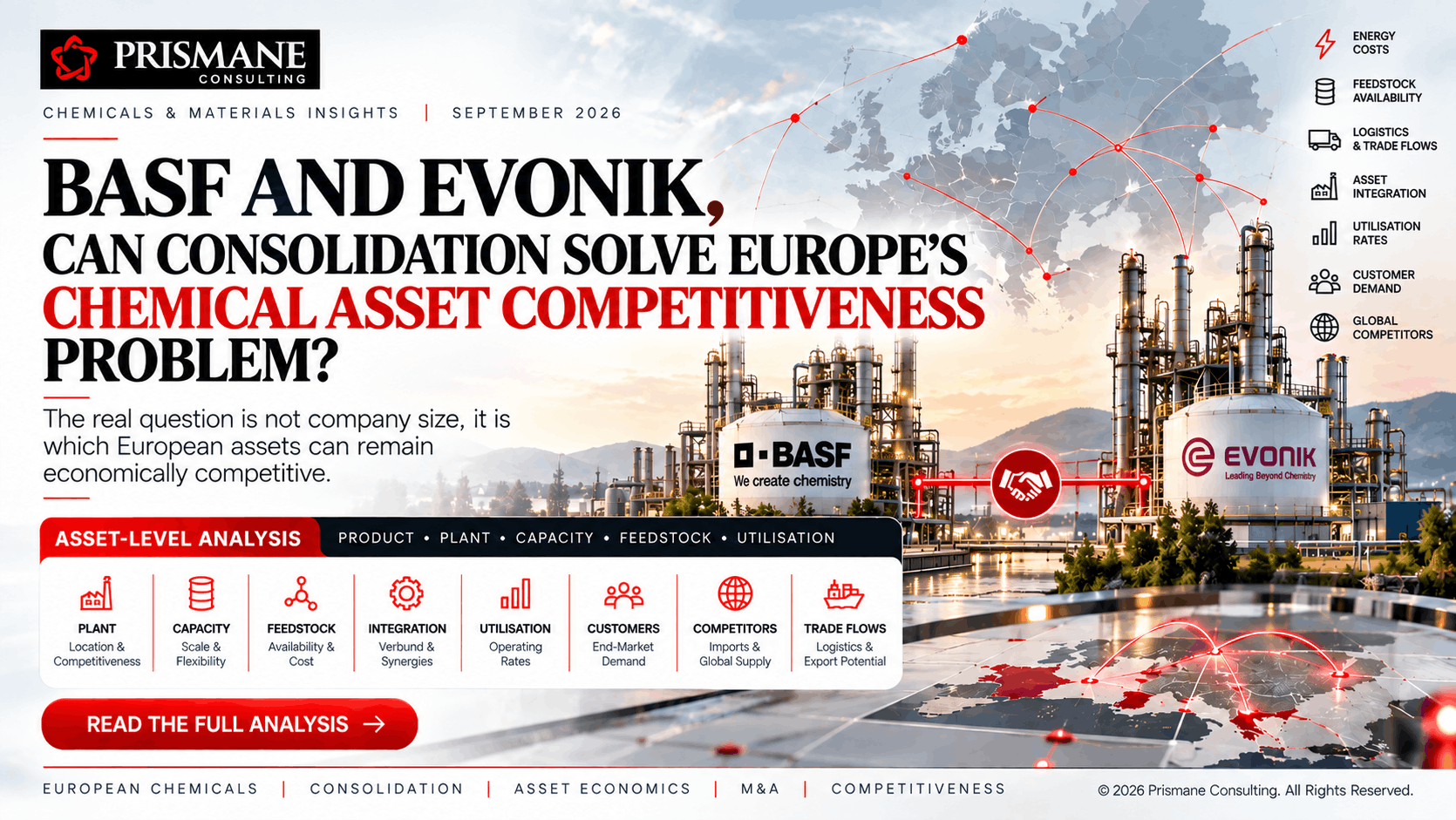
BASF's approach to Evonik is about more than the potential combination of two major German chemical companies. It raises a broader question for Europe's chemical industry: can consolidation improve the competitiveness of European chemical assets, or does it simply create a larger company facing the same structural cost pressures?
On 25 September 2026, BASF confirmed exploratory discussions with Evonik and RAG-Stiftung regarding a potential takeover of Evonik. BASF stressed that the course and outcome remain open. Evonik separately confirmed that it had received a non-binding approach from BASF for all its shares. No transaction has been agreed.
The timing is significant. Both companies are already reshaping their portfolios, reducing exposure to businesses facing difficult economics and concentrating capital on activities where they see stronger long-term potential. A BASF-Evonik combination would therefore come into an industry already undergoing structural consolidation.
The central issue is not whether the combined company would be larger. It is which businesses and assets would become more competitive through combination, which would become redundant, and whether any assets requiring divestment could attract viable industrial buyers.
Europe's chemical problem is increasingly an asset problem
Europe does not have a single chemical industry competitiveness problem. Different plants face different combinations of energy costs, feedstock economics, scale, utilisation, logistics, imports and integration. One asset may remain competitive because it is deeply integrated into a large production complex. Another may face persistent pressure because it relies on expensive imported feedstocks or operates below efficient scale. A third may have strong technology and customer relationships but an increasingly difficult manufacturing cost base.
This distinction matters for BASF and Evonik because both companies have already started addressing individual assets rather than treating their entire European footprints uniformly.
BASF's current strategy acknowledges that selected plants and production lines at Ludwigshafen no longer deliver sufficient earnings or face competitiveness risks, while stating that the majority of assets remain competitive. The company is therefore restructuring the site while continuing to position Ludwigshafen as a major European chemical hub.
Evonik is taking a similar asset-level approach. In June 2026, it announced the discontinuation of its global polyester business, citing global competitive pressure, structural disadvantages in Europe and declining market dynamics. In September, it announced the planned closure of its Bitterfeld chlorosilanes site, citing difficult market conditions, increasing supply from Asia and prolonged low utilisation. Evonik said it had examined alternative operating concepts, capacity reductions, mothballing and sale options but had not identified a sustainable long-term economic solution.
The message from both companies is clear: portfolio restructuring is increasingly being driven by the economics of individual businesses and plants. That makes a potential combination particularly interesting.
BASF is not breaking into three companies, but its structure is changing
The idea of a major BASF restructuring has historical precedent. In 2018, after DowDuPont announced plans to separate into three companies, BASF's then chief executive explicitly rejected a similar breakup and defended the integrated Verbund model, arguing that integration remained central to BASF's competitive position.
BASF has not subsequently adopted a three-company structure. But its portfolio has become considerably more modular. By 2026, BASF had organised its activities around four core businesses: Chemicals, Materials, Industrial Solutions, and Nutrition & Care, alongside standalone businesses including Surface Technologies and Agricultural Solutions. BASF has also launched CoreShift, targeting up to 20% lower net cash fixed costs in its core businesses by 2029 compared with the 2024 baseline.
The portfolio changes are significant. BASF completed the sale of its Coatings business in June 2026 while retaining a 40% stake in the new Surventis business. Agricultural Solutions is being prepared for potential IPO readiness by mid-2027, although BASF has not made a final execution decision.
The relevant question is therefore no longer whether BASF will copy the DowDuPont model. It is whether BASF is developing a more selective version of the Verbund model, retaining integration where it creates value while giving greater independence to businesses with different strategic or competitive characteristics. That context matters when considering Evonik: BASF could use its scale and integration to strengthen selected Evonik businesses, while applying the same portfolio discipline it is applying to its own assets.
Why Evonik is strategically interesting to BASF
Evonik's portfolio is more specialised than BASF's and includes positions in speciality chemicals, additives, nutrition, personal care, performance materials and intermediates. That creates several potential areas of strategic fit.
Personal care and formulation ingredients
Both companies have positions across ingredients and technologies used in personal care and related formulations. Potential overlap areas include:
Product area | Strategic issue |
Emollients and emulsifiers | Degree of direct product overlap |
Surfactants | Regional capacity and import competition |
Active ingredients | Customer qualification and substitution |
Conditioning ingredients | Application-specific competition |
Film-forming polymers | Product differentiation |
UV filters | Concentration and alternative suppliers |
Ceramides and sphingolipids | Speciality positioning |
Biosurfactants | Technology and future competition |
Delivery systems | Formulation know-how and customer relationships |
The important point is that overlap cannot be assessed at the business-unit level. Two companies can appear to compete in the same category while offering products with different applications, grades or qualification requirements. Conversely, products housed in different organisational units can compete directly for the same customer. The analysis therefore needs to move from company to product.
Additives and performance materials
A similar assessment applies to plastics and speciality additives. Potential areas include antioxidants, light stabilisers, UV absorbers, process additives, functional additives, silanes, silica and selected recycling-related technologies. The relevant questions include:
- Which specific grades overlap?
- What are the capacities and locations?
- Which products are qualified by major customers?
- How easily can customers switch suppliers?
- What imports are entering Europe?
- Which competitors have available capacity?
- Are BASF and Evonik competing globally or primarily in particular regions?
These details can materially change the competition assessment.
Animal nutrition
Evonik's animal nutrition business provides another potentially important workstream, particularly methionine. Evonik has a large global MetAMINO DL-methionine position, including a major production base in Singapore. BASF also participates in animal nutrition through its methionine hydroxy analogue chemistry.
The relevant assessment would need to distinguish global market position from regional supply, mapping global capacity through to regional capacity, plant-level production, utilisation, trade flows, customers, competitors and announced capacity. This is especially important for products where Europe can be supplied from highly competitive production hubs elsewhere in the world.
Coatings and formulation chemistry
Coatings requires a more careful approach because BASF's portfolio has changed. BASF completed the sale of its Coatings business in June 2026, retaining a 40% stake in Surventis, which combines automotive OEM coatings, automotive refinish coatings and surface treatment activities. Therefore, the former BASF Coatings business should not be treated as wholly owned BASF activity in any current assessment. Potential overlap may instead sit further upstream, in resins, additives, formulation chemistry, crosslinkers, speciality materials and related technologies. This is another example of why the ownership perimeter must be mapped before analysing market concentration.
Evonik's restructuring could make the transaction more complex
Evonik is not approaching the BASF proposal with its portfolio unchanged. In September 2026, it announced plans to divest Oxeno and Syneqt as part of its strategy. Oxeno is a significant C4 chemicals business with production assets in Germany and Belgium and products including 1,3-butadiene, isobutene, butene-1, MTBE, oxo alcohols and plasticisers.
This creates several possible transaction scenarios. A BASF-Evonik transaction could involve businesses that BASF wants to acquire, businesses it wants to integrate, businesses it would prefer to sell and businesses that regulators might require to be divested. The eventual perimeter could therefore be substantially different from Evonik's current portfolio.
The real competition question: what happens to the assets?
This is where the transaction moves beyond conventional M&A analysis. If BASF and Evonik overlap in particular product markets, competition authorities could examine whether the combination materially reduces competition. European merger precedents show that such analysis can extend well beyond company-level market shares.
INEOS and Solvay
The INEOS-Solvay transaction is particularly relevant because it involved two major European chemical groups and vertically integrated production chains. The European Commission examined markets including commodity PVC in Northwest Europe and sodium hypochlorite in parts of Europe, and remedies included divestments of integrated assets across several European countries. The lesson is the methodology: competition analysis can require assessment running from product, to plant, to capacity, geography, feedstock, integration, customer access and competing capacity. That framework is highly relevant to BASF and Evonik.
Dow and DuPont
The DowDuPont transaction provides another example. The European Commission identified concerns in specific crop protection markets as well as in acid copolymers and ionomers. Remedies included divestments covering crop protection activities and Dow's acid copolymers and ionomers businesses. Again, the transaction was assessed product market by product market rather than through the combined companies' overall size.
Bayer and Monsanto
The Bayer-Monsanto review shows how the analysis can also extend to innovation and future competition. The European Commission examined more than 2,000 product markets and considered competition in seeds, pesticides, digital agriculture and innovation. For BASF and Evonik, this could be relevant in technology-intensive speciality chemicals, where competition depends not only on current production but also on formulation know-how, intellectual property, customer qualification and future product development.
The divestment paradox
Suppose a BASF-Evonik transaction creates competition concerns in a particular product. The conventional remedy is straightforward: divest the overlapping business to another company. The industrial question is much harder. Who can actually operate the asset competitively in Europe? Potential buyers could include:
Buyer type | Potential rationale | Key challenge |
European chemical producer | Existing infrastructure and customer base | May face the same European cost structure |
Asian producer | Competitive manufacturing economics | May have limited interest in European production |
Middle Eastern producer | Feedstock advantages and capital | May favour production in lower-cost regions |
US chemical producer | Global scale and technology | Europe may not fit its cost structure |
Private equity | Ability to restructure and specialise | May require substantial capital |
Specialist chemical producer | Product expertise | May lack feedstock or site integration |
Site or infrastructure operator | Ability to preserve industrial ecosystem | May lack chemical operating capabilities |
Joint venture | Shared capital and risk | More complex ownership and governance |
The critical distinction is between a buyer and a viable purchaser. A buyer may be willing to acquire an asset. A viable purchaser needs to operate it, retain customers, secure feedstocks, maintain technology and invest sufficiently to compete. That distinction could become one of the most important issues in any regulatory review of BASF-Evonik.
Leuna Polyamid illustrates the problem
The Leuna Polyamid situation is a sharper illustration of this than it first appears, because the story did not stop at a single rescue.
DOMO Caproleuna, a producer of caprolactam and polyamide 6, saw its German entities file for insolvency at the end of December 2025 after financing talks with lenders collapsed. InfraLeuna and Leuna-Harze stepped in as a rescue vehicle, and the site's assets and around 436 of its roughly 500 jobs were transferred to the newly formed Leuna-Polyamid GmbH on 1 April 2026, averting an unsafe winter shutdown of the plant.
The rescue did not hold. By mid-June 2026, barely two and a half months later, Leuna-Polyamid itself filed for self-administered insolvency, after raw material costs (sulphur, benzene and propylene) rose 40 to 100% on the back of wider geopolitical shocks in the Gulf region. Production continued through the summer while administrators searched for a longer-term investor. That search failed: by 9 September 2026, it was confirmed there was no viable buyer, and Leuna-Polyamid announced production would stop at the end of September 2026, with formal insolvency proceedings expected to open in early October, affecting around 400 jobs.
A site can go from rescued to closing for good within five months, under two different owners, without the underlying feedstock and energy economics ever changing. That is the sharpest version of the point: strategic importance to an industrial cluster does not automatically translate into economic viability, and the same principle applies directly to any divestment that might result from a BASF-Evonik merger review. A remedy can preserve an independent owner and an apparent competitor. If the asset remains structurally disadvantaged, ownership alone will not preserve sustainable European production.
The plant, not the company, is the critical unit of analysis
For European chemical consolidation, the relevant analysis needs to move beyond the corporate level and into the economics of individual products and plants:
- Company: who owns the business?
- Business: what strategic role does it play?
- Product: what exactly is being sold?
- Plant: where is it manufactured?
- Capacity: what is the nameplate and effective capacity?
- Feedstock: what raw materials and energy does it require?
- Integration: does it benefit from upstream or downstream integration?
- Utilisation: how efficiently is the asset operating?
- Customers: how concentrated are sales and how difficult is qualification?
- Competitors: who can supply the same product?
- Trade flows: how much product can enter Europe from elsewhere?
- Future capacity: which new projects or expansions could change the market?
- Economics: can the plant generate sustainable returns under European cost conditions?
This framework can reveal something that corporate-level analysis cannot: two plants producing nominally similar products may have completely different competitive positions.
What BASF-Evonik could ultimately tell us about Europe
The potential BASF-Evonik transaction comes at a point when European chemicals is moving from broad portfolio expansion towards much more selective capital allocation. BASF is reshaping its portfolio while retaining the integrated core of its Verbund model. Evonik is exiting or preparing to divest businesses where it sees insufficient long-term economics. European plants are increasingly being evaluated on their individual competitiveness rather than simply their strategic importance.
A BASF-Evonik combination would bring these trends together. For some assets, greater scale, integration and customer reach could improve economics. For others, consolidation could accelerate rationalisation. Some overlapping businesses could require divestment, while other assets might be strengthened through integration.
The critical issue would then be whether a divested asset has a credible path to remaining competitive in Europe. As Leuna Polyamid shows, a remedy can preserve an independent owner and an apparent competitor, but if the underlying cost, feedstock, utilisation or scale disadvantages remain, ownership alone will not preserve sustainable production.
This is also why the old question of whether BASF might eventually split into three companies is less relevant today. BASF rejected the DowDuPont-style breakup model in 2018, and there is no verified current plan for a three-way separation. What has changed is the way BASF distinguishes between businesses that benefit from integration and those that can operate with greater independence.
The BASF-Evonik question therefore goes beyond transaction size, market share or corporate structure. It is fundamentally about which assets Europe can still operate competitively, which require consolidation, and which no longer have an economic reason to remain in Europe. In European chemicals, ownership is only one part of the equation. The more important question is whether the asset has a sustainable economic reason to exist in Europe, and whether its owner has the capabilities and capital to keep it competitive. That is the real test for BASF, Evonik and the future structure of Europe's chemical industry.
Frequently asked questions
Will the EU block a BASF-Evonik merger?
It is too early to determine the outcome. The European Commission's review of Dow and DuPont in 2017 illustrates that competition concerns can arise in specific product markets even when the overall transaction involves much larger companies. In acid copolymers, for example, the Commission identified concerns because the number of credible suppliers would have fallen from four to three. The Commission also examined other areas, including ionomers, pesticides and innovation, and accepted remedies designed to preserve competition. For BASF and Evonik, the relevant assessment would similarly depend on the specific products, geographic markets, competitive alternatives and assets affected.
What products overlap between BASF and Evonik?
The clearest overlaps are in animal nutrition amino acids (Evonik's DL-methionine versus BASF's methionine hydroxy analogue chemistry), coatings and polymer additives, and personal care ingredients such as emollients and surfactants. Evonik's 2024 sale of its superabsorbent polymer business removed the cleanest acrylics-chain overlap with BASF.
Why did Leuna Polyamid go insolvent twice in one year?
Leuna Polyamid was formed in April 2026 to rescue the insolvent DOMO Caproleuna site. It filed for its own insolvency just two and a half months later, in June 2026, after raw material costs spiked 40 to 100% amid Gulf region geopolitical shocks. By September 2026, a viable buyer still hadn't been found and production was set to stop, showing that a change of ownership alone didn't fix the plant's underlying cost structure.
Is BASF splitting into three companies like DowDuPont did?
No. BASF's chief executive rejected that model in 2018. Instead, BASF has taken a more selective approach: carving out standalone businesses like Coatings (now Surventis) and Agricultural Solutions while keeping its core Chemicals, Materials, Industrial Solutions and Nutrition & Care segments tightly integrated under its Verbund model.
How big would a combined BASF-Evonik be?
BASF generated around €60 billion in sales in 2025, while Evonik generated around €14 billion, implying combined annual sales of roughly €74 billion before any portfolio changes. The more important issue, however, would not be the combined company's overall size but how its individual businesses and assets would be positioned across European and global markets.
Prismane Consulting analyses chemical industry consolidation at exactly this level, company, business, product, plant, capacity, location, feedstock, integration, utilisation, customers, competitors and trade flows, through its Chemicals and Materials practice. For a closer, plant-level look at how a BASF-Evonik combination would reshape European speciality chemicals, write to us at sales@prismaneconsulting.com.