
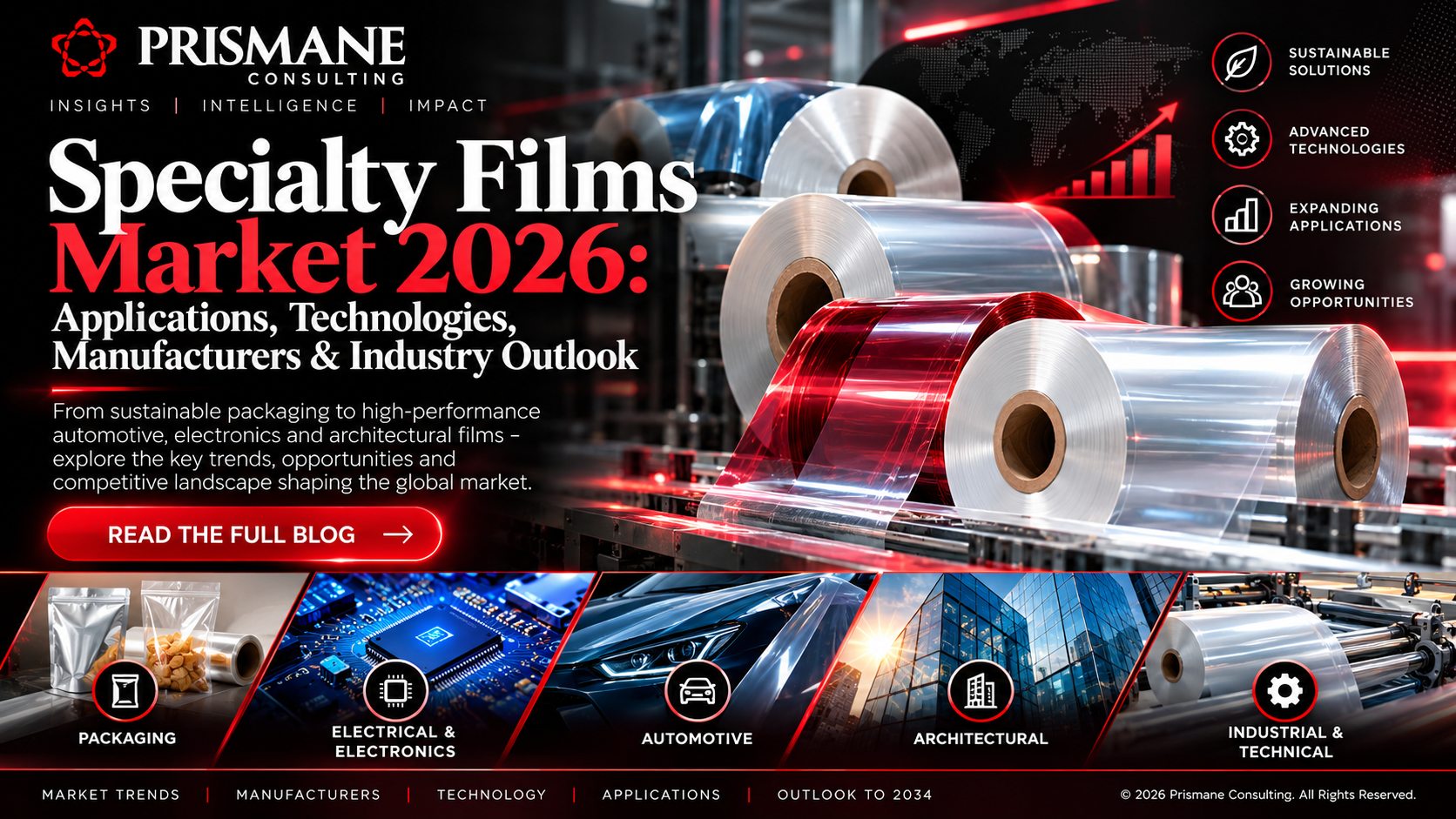
Specialty Films Are Moving From Commodity Substrates to Engineered Materials
The specialty films industry is undergoing a structural transformation. Films that were once primarily differentiated by thickness, clarity, strength, printability and cost are increasingly being engineered around specific functional requirements. Packaging remains a major demand centre, but specialty films are expanding into automotive, architecture, electrical and electronics, optical, industrial, graphics and other specialized applications.
The basis of competition is changing with it. The value of a film increasingly depends not only on the polymer from which it is produced, but also on orientation, multilayer construction, coating, metallization, surface treatment, barrier performance, electrical properties and compatibility with downstream processing.
Recent developments across the industry illustrate this shift. Polyplex and SRF are developing BOPE and BOPP-BOPE structures for recyclable packaging, while Jindal Films is expanding PP-based mono-material and barrier film solutions. Surya Global Flexifilms is investing in transparent high-barrier BOPP through AlOx metallisation. SRF is moving into capacitor-grade BOPP, while Polyplex is developing technical PET applications. Dhunseri Poly Films is investing in high-speed BOPET production, and Garware Hi-Tech Films is moving further upstream through its collaboration with Lubrizol on TPU-based products. Taken together, these developments point towards a specialty films industry that is increasingly moving from commodity substrates towards engineered functional materials.

What Are Specialty Films?
Specialty films are high-performance film materials designed to meet specific functional, technical or aesthetic requirements. Unlike more standardized commodity films, they are typically engineered for applications where properties such as optical performance, durability, heat resistance, surface protection, insulation, barrier performance, chemical resistance or dimensional stability are important.
The specialty films market covers a broad range of applications, including flexible packaging, labels, electrical and electronics, automotive protection, architectural films, industrial applications, graphics, release liners and thermal-control films. The distinction between commodity and specialty films, however, is becoming less straightforward.
A conventional BOPP or BOPET platform can become a specialty material when it is engineered for a demanding application. Capacitor-grade BOPP, optical PET films, transparent high-barrier BOPP and automotive TPU films demonstrate this transition. Specialty films are therefore increasingly defined not simply by the polymer used, but by the performance requirements and technology embedded in the final film.
Packaging Films Are Being Redesigned Around Material Compatibility
Packaging remains one of the largest application areas for the film industry, but packaging structures are changing rapidly. The movement towards recyclable and mono-material packaging is encouraging greater use of polyethylene- and polypropylene-based structures. Instead of optimizing individual layers independently, film producers and converters are increasingly designing the complete packaging structure around material compatibility while maintaining mechanical strength, sealability, printability and barrier performance.
BOPE is particularly relevant to this transition. Polyplex offers BOPE films for printing and lamination applications that can be incorporated into mono-material PE packaging structures. SRF is also developing BOPP-BOPE capabilities as part of its value-added film portfolio.
Jindal Films provides another example of this direction, with PP-based mono-material structures designed to support recyclable packaging while maintaining the performance required for demanding applications. The significance extends beyond individual products. The mono-material transition is changing the architecture of flexible packaging itself.
Barrier Performance Is Moving Towards Functional Layers
Barrier performance is another area in which the specialty films industry is becoming increasingly technology intensive. Conventional high-barrier packaging has often relied on complex structures combining several materials. Coatings, metallization and transparent inorganic barrier layers are now providing alternative ways of achieving oxygen and moisture protection while reducing material complexity.
Surya Global Flexifilms, for example, is adding AlOx metallization capability for transparent high-barrier BOPP films. This technology allows barrier performance to be incorporated into a transparent film structure rather than relying exclusively on conventional foil-based solutions. Toppan's GL BARRIER portfolio similarly demonstrates the development of high-barrier PET, PP and other film structures for packaging applications, including solutions designed around mono-material concepts.
These developments point towards a broader change: barrier performance is increasingly being created through thin functional layers engineered onto film substrates. Metallization, coatings and surface treatments are therefore becoming increasingly important competitive technologies alongside polymer selection and film orientation.
BOPP Is Expanding Beyond Conventional Packaging
BOPP has historically been strongly associated with flexible packaging, labelling and related applications. Increasingly, however, the material is being engineered for technical applications. Capacitor-grade BOPP is an important example. SRF has been developing capacitor-grade BOPP production in India, and in 2026 Cosmo First launched its own metallized capacitor-grade BOPP films, reinforcing the development of domestic capacity in this technical segment.
Capacitor films require a very different combination of properties from conventional packaging films. Thickness uniformity, dielectric performance, electrical reliability and process consistency become critical. The connection with electric vehicles, power electronics, renewable energy and broader electrification trends creates an additional demand pool for BOPP film technology.
This illustrates how established film platforms can enter higher-value applications when manufacturers develop the required material and processing capabilities.
BOPET Is Moving Further Into Technical Applications
The evolution of BOPET follows a similar path. Polyplex's PET film portfolio spans packaging as well as electrical, electronics, display and other technical applications. The company has highlighted applications including flexible electronics and MLCC-related uses, demonstrating the increasing range of requirements that can be addressed through engineered PET films.
At the manufacturing level, Dhunseri Poly Films provides another example of the industry's technological progression. The company has ordered a BOPET line designed for a production speed of 700 meters per minute, highlighting the industry's focus on productivity and manufacturing efficiency. High-speed, wide-web production is important because technical films still need to be manufactured at commercial scale.
As customers demand thinner films, tighter tolerances and more complex structures, process control becomes increasingly important. The competitive equation is therefore shifting towards a combination of material technology, process technology and application expertise.
Optical Films Are Creating New High-Value Applications
Optical films represent another area where conventional film platforms are becoming highly engineered materials. Display and electronics applications require extremely tight control over thickness, surface quality, optical characteristics and dimensional stability. These requirements create a substantially different competitive environment from conventional packaging films.
Continued investment in optical-film capacity in China, including new multilayer optical-film lines and BOPET optical-film production, demonstrates the continuing expansion of film technologies into these applications. The significance of optical films lies in the technical requirements involved.
The ability to manufacture a film consistently at tight specifications can become more important than simply having large nominal capacity. This reinforces a broader trend in the specialty films market: film volume and film value are increasingly becoming two different variables.
Automotive Films Are Becoming Advanced Material Platforms
Automotive applications provide another clear example of the movement towards functional films. Paint protection films, window films and other automotive products require combinations of optical clarity, flexibility, weather resistance, surface performance and long-term durability.
Garware Hi-Tech Films provides an example of this transition in India. The company's collaboration with Lubrizol is intended to develop and manufacture TPU-based products in India across automotive, architectural, industrial, electronics and other specialty applications. The planned TPU platform is also intended to support backward integration for its premium paint protection film business. The development demonstrates how specialty film manufacturers can move upstream into material technology when control over the underlying polymer becomes important to final-film performance. The automotive specialty films market is consequently becoming more closely connected with polymer development, extrusion, coating and application engineering.
Architectural Films Are Moving Towards Functional Performance
Architectural films are also moving beyond purely decorative applications. Window and glazing films can provide solar control, infrared rejection, privacy, safety and decorative effects. As building owners and developers focus more closely on energy consumption and occupant comfort, functional properties are becoming increasingly important.
Garware's architectural film portfolio provides one example of this diversification, spanning spectrally selective, infrared-rejection, safety, privacy, designer and reflective films. Architectural films demonstrate how a film can become part of a building's functional system rather than simply serving as a surface treatment. This creates opportunities for manufacturers that can combine optical performance, durability and energy-management characteristics within a thin film structure.
Surface Engineering Is Becoming as Important as the Base Film
One of the most significant changes across the specialty films industry is the increasing importance of what happens after the base film is produced. Metallization, AlOx and other barrier coatings, silicone coatings, release coatings, surface treatments and functional topcoats can substantially modify film performance.
Polyplex operates downstream capabilities spanning metallization and coating technologies. Jindal Films has developed metallized and high-barrier structures, while Surya Global Flexifilms is investing in advanced metallization for transparent barrier applications.
This creates a more sophisticated value chain in which a film producer can differentiate a product through a combination of polymer selection, orientation and surface engineering. The industry is consequently moving towards a model where the substrate provides the platform and surface engineering creates the functionality.
Manufacturing Technology Is Becoming a Competitive Differentiator
Product innovation is only one side of the industry's evolution. Manufacturing technology is changing rapidly as well. Wider film lines, higher production speeds, advanced stretching technologies, improved winding systems and increasingly automated process control are allowing manufacturers to produce sophisticated films at greater scale. Dhunseri's planned 700-metre-per-minute BOPET line illustrates this emphasis on manufacturing productivity. The company's production platform also incorporates downstream capabilities including slitting, metallization and recycling.
The importance of manufacturing technology increases as film structures become thinner and specifications become tighter. A technically attractive film has limited commercial value if it cannot be produced consistently and economically at scale. The next phase of competition will therefore increasingly involve both product engineering and production engineering.
India Specialty Films Market: Manufacturing and Technology Outlook
India is becoming an important example of the wider transformation taking place across the specialty films industry. The country's capabilities are expanding across BOPP, BOPET, BOPE, metallization, barrier films and technical applications. SRF is developing capacitor-grade BOPP and BOPP-BOPE structures, Dhunseri is investing in high-speed BOPET production, Surya Global Flexifilms is developing BOPP, BOPET and BOPE alongside advanced metallization, and Polyplex continues to operate an integrated platform spanning film production and downstream specialty technologies.
Garware's planned TPU platform adds another dimension by connecting specialty film manufacturing with advanced polymer technology and backward integration. The importance of India therefore extends beyond growing domestic packaging consumption.
The country is developing capabilities across both large-scale packaging films and increasingly specialized technical materials. Global technology partnerships are also becoming relevant, with the Garware-Lubrizol collaboration demonstrating how international polymer technology can be combined with domestic film manufacturing and application development.
Capacity Growth Does Not Automatically Mean Value Growth
The expansion of film capacity is creating a more complex competitive landscape. Large BOPP and BOPET investments can increase supply availability and intensify competition in relatively standardized applications. At the same time, technical films can require specialized equipment, longer customer qualification cycles, application development and closer technical relationships.
This creates an important distinction between capacity additions aimed primarily at volume growth and investments designed around differentiated applications. A new BOPP line supplying conventional packaging applications competes in a different market environment from a capacitor-grade BOPP line or a high-barrier BOPP line. The same distinction applies to BOPET, where large-scale packaging capacity and highly specialized electrical, optical or industrial films can involve substantially different competitive dynamics.
For producers, converters and investors, capacity additions therefore need to be assessed not simply by tonnage, but by film type, application, technology, customer qualification and degree of differentiation.
Sustainability Is Becoming an Engineering Requirement
Sustainability remains one of the strongest forces influencing film development, but its role is becoming increasingly technical. The industry is moving beyond simple material reduction towards mono-material structures, recyclable architectures, recycled-content films, high-barrier coatings and other technologies that seek to maintain performance while improving end-of-life compatibility.
BOPE, BOPP-BOPE structures, PP mono-material packaging, transparent barrier films and recycled-content film technologies represent different approaches to the same underlying challenge. The objective is not simply to make a film more sustainable. The film must still provide the required mechanical performance, barrier protection, sealability, printability and processing characteristics. This is why sustainability is increasingly becoming an engineering problem rather than simply a material-selection problem.
For manufacturers, the opportunity is increasingly moving beyond additional capacity towards differentiated products, technical qualification, application development and deeper customer integration.

The Specialty Films Value Chain Is Becoming More Integrated
As film technology becomes more sophisticated, the boundaries between polymer producers, film manufacturers, coating companies, metallizers, converters and end users are becoming less distinct.
A high-barrier packaging film may require coordination between polymer selection, orientation, coating, metallization, printing and sealing. A capacitor film requires tight control of thickness and electrical properties. An automotive protection film can depend on the performance of the underlying TPU as much as the film-processing technology.
The Garware-Lubrizol development is a clear example of this upstream-downstream integration. Rather than treating TPU simply as an externally sourced raw material, the development connects polymer technology with film extrusion and the downstream paint protection film application.
This type of integration can enable greater control over product specifications, quality, application development and supply chains. The specialty films industry is therefore increasingly becoming a materials-engineering and application-development business.
The Competitive Structure of Specialty Films Is Changing
The developments across packaging, automotive, electrical, electronics, optical, architectural and industrial applications point towards the same structural shift. Specialty films are becoming increasingly performance-driven rather than substrate-driven.
Packaging will remain a major source of demand, but the requirements within packaging are becoming more sophisticated. BOPE and mono-material structures are changing packaging architecture. High-barrier coatings and metallization are changing how barrier performance is achieved. Capacitor films are opening new applications for BOPP. Electronics and optical applications are creating demand for films with tighter specifications. Automotive and architectural applications are creating opportunities for films engineered around long-term functional performance.
At the same time, wider and faster production lines are allowing increasingly sophisticated films to be produced at commercial scale. For producers, converters and investors, the relevant question is therefore no longer simply how much film the market will consume.
The more important questions concern which film structures will gain adoption, which applications will require higher functionality, where new capacity will be added, and how quickly technical film technologies can move from development to commercial production.
Specialty Films Market Outlook Through 2034
The specialty films market is moving toward a more differentiated competitive structure. Packaging will remain a critical volume base, but higher-value applications are expanding the addressable opportunity for manufacturers with specialized technologies. BOPP and BOPET are being adapted for electrical, optical and technical applications, while BOPE, high-barrier structures and metallization are reshaping packaging films.
At the same time, automotive, architectural and industrial applications are creating demand for films designed around specific performance requirements. Through 2034, the competitive advantage of specialty film producers is likely to increasingly depend on the combination of:
Material technology, processing capability, surface engineering, manufacturing scale and application expertise. Capacity will remain important, but capacity alone will not determine value creation.
The ability to manufacture highly specified films consistently, qualify products with demanding customers and develop solutions around specific applications will become increasingly important as the market moves further toward engineered functional materials.
At Prismane Consulting, we see this evolution as part of a broader transformation across the advanced materials value chain. Specialty films increasingly sit at the intersection of polymer science, film orientation, surface engineering, coating and metallization, converting technology and end-use application development.
The companies developing these capabilities are not simply producing thinner sheets of polymer. They are increasingly engineering materials around the performance requirements of specific applications. That shift is likely to remain central to the evolution of the global specialty films industry.
For manufacturers, converters, material suppliers and investors, understanding where technology, capacity and application demand intersects will be critical to identifying the next areas of growth.
Explore Prismane Consulting's Global Specialty Films Market Study for deeper analysis of market structure, applications, technologies, capacity developments and competitive dynamics contact: sales@prismaneconsulting.com