
The Growing Strategic Importance of Used Cooking Oil
As governments, industries, and consumers increasingly prioritize sustainability, Used Cooking Oil (UCO) has emerged as one of the most valuable waste-derived feedstocks in the global circular economy. Once regarded merely as a waste product generated by restaurants, food processors, hotels, and households, UCO is now a critical raw material supporting the production of renewable fuels, sustainable aviation fuel (SAF), hydrotreated vegetable oil (HVO), biodiesel, and various oleochemical products.
The transformation of UCO from waste to resource reflects broader trends shaping the global energy landscape: decarbonization, renewable fuel adoption, waste management optimization, and circular economy initiatives. As demand for low-carbon fuels accelerates, competition for UCO supplies is intensifying, positioning the feedstock as a strategic commodity within global biofuel value chains.
What is Used Cooking Oil (UCO)?
Used Cooking Oil (UCO) refers to vegetable oils and animal fats that have been utilized for cooking and food processing purposes and are no longer suitable for human consumption due to degradation, contamination, and changes in chemical composition. Common sources include restaurants, hotels, catering services, food manufacturers, fast-food chains, and residential households.
Rather than being discarded through sewage systems or landfills, collected UCO can be processed and upgraded into a variety of value-added products, including:
- Biodiesel
- Renewable Diesel (HVO)
- Sustainable Aviation Fuel (SAF)
- Oleochemicals
- Soaps and detergents
- Lubricants and coatings
- Industrial chemicals
Among these applications, renewable fuels account for the overwhelming majority of global UCO consumption.
UCO at the Center of the Renewable Fuels Industry
Renewable Diesel and Biodiesel Production
The biofuels sector remains the primary demand driver for UCO globally. Renewable diesel and biodiesel producers increasingly favor UCO because it offers significantly lower lifecycle carbon emissions compared to virgin vegetable oils such as soybean, rapeseed, and palm oil.
As a waste-based feedstock, UCO delivers superior greenhouse gas (GHG) reduction performance, making it highly attractive for compliance with low-carbon fuel programs and renewable fuel mandates.
Compared to first-generation biofuels, UCO-based fuels offer:
- Lower carbon intensity scores
- Improved sustainability credentials
- Reduced indirect land-use change concerns
- Greater regulatory incentives and credits
- Enhanced acceptance among corporate sustainability programs
These advantages have elevated UCO to one of the most sought-after feedstocks within renewable diesel and biodiesel production networks.
Hydrotreated Vegetable Oil (HVO): Driving Premium Demand
Hydrotreated Vegetable Oil (HVO), often referred to as renewable diesel, has become one of the fastest-growing end-use sectors for UCO.
Unlike conventional biodiesel, HVO possesses fuel characteristics nearly identical to petroleum diesel, enabling direct usage without blending limitations. Furthermore, HVO delivers:
- Significant reductions in carbon dioxide emissions
- Lower particulate matter emissions
- Reduced nitrogen oxide (NOx) emissions
- Near-zero sulfur oxide (SOx) emissions
- Improved cold-weather performance
The expansion of HVO production capacity across Europe, North America, and Asia-Pacific has significantly increased demand for waste-based feedstocks such as UCO.
Sustainable Aviation Fuel (SAF): The Next Growth Frontier
The aviation industry is emerging as a major future consumer of UCO-derived fuels.
With airlines facing increasing pressure to reduce carbon emissions and achieve net-zero targets, Sustainable Aviation Fuel (SAF) has become a key decarbonization pathway. UCO is among the most preferred feedstocks for SAF production because of its favorable lifecycle emissions profile and strong regulatory recognition.
Major SAF producers continue to expand production capacity globally, creating additional competition for available UCO supplies. Airlines, logistics providers, and freight operators are increasingly entering long-term SAF procurement agreements to support their sustainability commitments, further strengthening feedstock demand.
Regulatory Support Continues to Strengthen Market Fundamentals
Government regulations remain the most influential factor driving global UCO demand.
European Union
The Renewable Energy Directives (RED II and RED III) have established ambitious renewable energy and transportation decarbonization targets. UCO is specifically recognized as an advanced feedstock under Annex IX Part B, making it highly valuable for compliance purposes.
United States
The Renewable Fuel Standard (RFS) and California's Low Carbon Fuel Standard (LCFS) provide substantial economic incentives for waste-based biofuel production. Additional benefits, including tax credits and renewable identification numbers (RINs), further enhance the attractiveness of UCO-derived fuels.
Emerging Markets
Countries including China, Singapore, and Canada are expanding renewable fuel programs and low-carbon fuel initiatives, creating new demand centers for UCO and strengthening global trade flows.
Environmental Benefits Beyond Fuel Production
The strategic value of UCO extends beyond renewable energy production.
Improper disposal of cooking oil can lead to:
- Sewer blockages
- Water contamination
- Increased waste management costs
- Illegal recycling into food supply chains
Recognizing these risks, governments are implementing dedicated collection programs and mandatory recycling requirements to improve recovery rates.
These initiatives support broader circular economy objectives by transforming waste streams into valuable industrial resources while simultaneously reducing environmental impacts.
Global Trade Dynamics Reshaping the UCO Market
UCO has evolved into a globally traded commodity.
Asia has become the dominant supply hub, exporting significant volumes to Europe and North America, where renewable fuel producers face strong regulatory incentives and premium pricing environments.
Several factors are supporting international trade growth:
- Favorable import policies
- Renewable fuel subsidies
- Tax credit programs
- Premium pricing for waste-based feedstocks
- Sustainability certification requirements
Certification schemes such as ISCC and RSB have become increasingly important, ensuring traceability, sustainability compliance, and eligibility for renewable fuel incentive programs.
As regulatory scrutiny intensifies, certified UCO supplies are expected to command growing premiums in international markets.
Supply Chain Integration and Feedstock Security
The rapid expansion of renewable fuel production has created significant concerns regarding feedstock availability.
To secure long-term supplies, leading biofuel producers are increasingly pursuing vertical integration strategies by investing directly in UCO collection networks, aggregation facilities, and trading operations.
Major renewable fuel producers have actively expanded feedstock procurement capabilities to reduce exposure to supply shortages and price volatility. This trend highlights the strategic importance of UCO within future renewable fuel supply chains.
Expanding Role in Oleochemicals and Consumer Products
Although biofuels dominate UCO consumption, the oleochemical industry remains an important secondary market.
UCO is increasingly utilized in the production of:
- Soaps
- Detergents
- Lubricants
- Coatings
- Industrial surfactants
- Personal care ingredients
Growing consumer demand for sustainable and recycled-content products is encouraging manufacturers to incorporate waste-derived feedstocks into product formulations, creating additional demand opportunities.
Technology Advancements Improving Feedstock Utilization
Technological innovation is expanding the range of applications for UCO.
Advancements in:
- Feedstock pre-treatment
- Contaminant removal
- Refining technologies
- Co-processing capabilities
have improved conversion efficiencies and enabled greater utilization of lower-quality UCO streams.
These developments are increasing the economic viability of UCO-based fuel production while supporting the expansion of advanced biofuel pathways.
Market Outlook
The global Used Cooking Oil (UCO) demand reached approximately 18 million tons in 2025. Demand is projected to expand at a CAGR of around 7% through 2034, reaching more than 33 million tons.
Several structural factors are expected to support long-term growth:
- Expansion of renewable diesel production capacity
- Rapid growth in Sustainable Aviation Fuel (SAF) demand
- Stricter carbon reduction policies globally
- Increasing adoption of circular economy initiatives
- Rising corporate net-zero commitments
- Growing sustainability certification requirements
- Expansion of UCO collection infrastructure
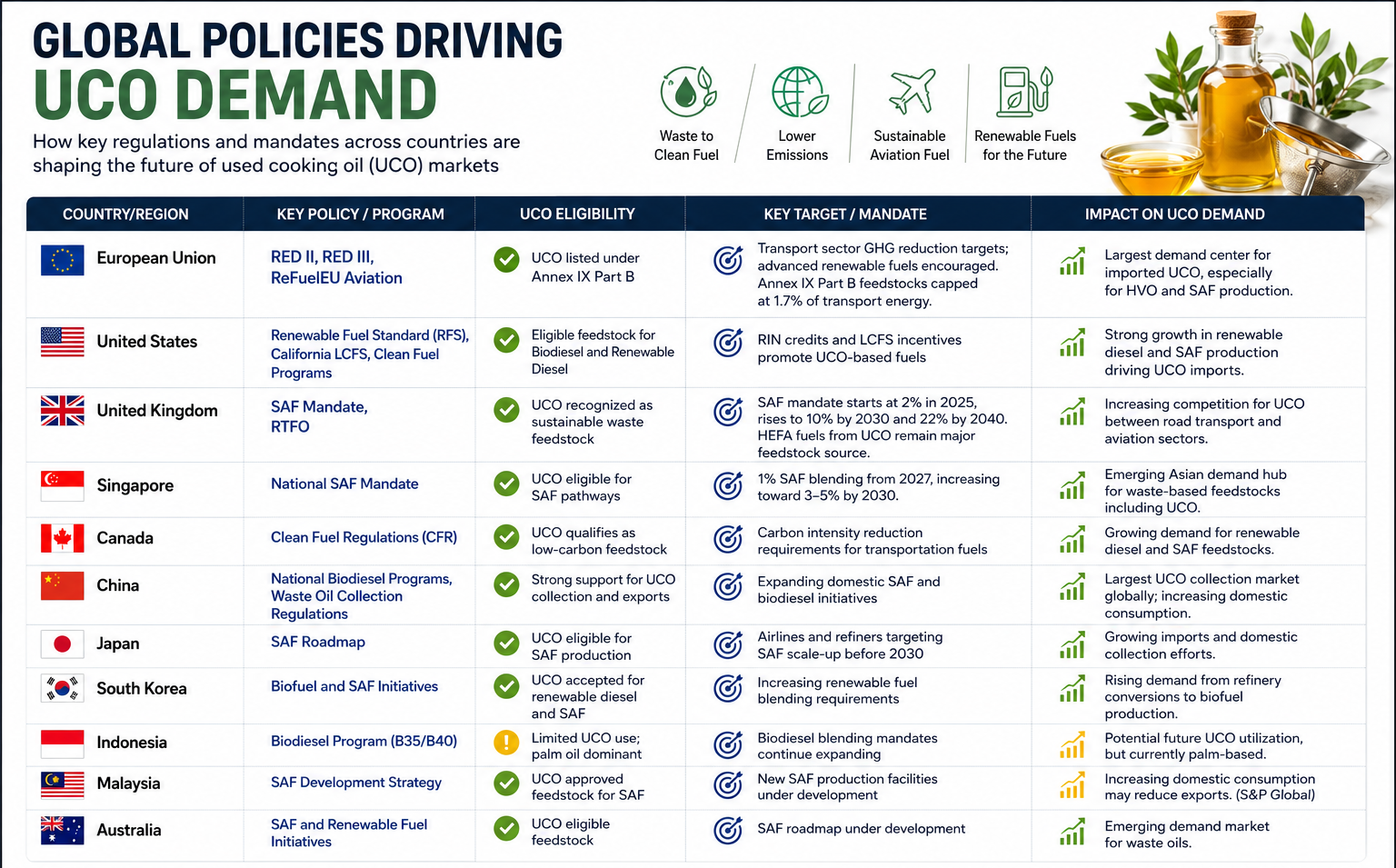
Table: Key policies, mandates, and targets
Country/Region | Key Policy/Program | UCO Eligibility | Key Target/Mandate | Impact on UCO Demand |
European Union | RED II, RED III, ReFuelEU Aviation | UCO listed under Annex IX Part B | Transport sector GHG reduction targets; advanced renewable fuels encouraged. Annex IX Part B feedstocks capped at 1.7% of transport energy. | Largest demand center for imported UCO, especially for HVO and SAF production. |
United States | Renewable Fuel Standard (RFS), California LCFS, Clean Fuel Programs | Eligible feedstock for Biodiesel and Renewable Diesel | RIN credits and LCFS incentives promote UCO-based fuels | Strong growth in renewable diesel and SAF production driving UCO imports. |
United Kingdom | SAF Mandate, RTFO | UCO recognized as sustainable waste feedstock | SAF mandate starts at 2% in 2025, rises to 10% by 2030 and 22% by 2040. HEFA fuels from UCO remain major feedstock source. | Increasing competition for UCO between road transport and aviation sectors. |
Singapore | National SAF Mandate | UCO eligible for SAF pathways | 1% SAF blending from 2027, increasing toward 3–5% by 2030. | Emerging Asian demand hub for waste-based feedstocks including UCO. |
Canada | Clean Fuel Regulations (CFR) | UCO qualifies as low-carbon feedstock | Carbon intensity reduction requirements for transportation fuels | Growing demand for renewable diesel and SAF feedstocks. |
China | National Biodiesel Programs, Waste Oil Collection Regulations | Strong support for UCO collection and exports | Expanding domestic SAF and biodiesel initiatives | Largest UCO collection market globally; increasing domestic consumption. |
Japan | SAF Roadmap | UCO eligible for SAF production | Airlines and refiners targeting SAF scale-up before 2030 | Growing imports and domestic collection efforts. |
South Korea | Biofuel and SAF Initiatives | UCO accepted for renewable diesel and SAF | Increasing renewable fuel blending requirements | Rising demand from refinery conversions to biofuel production. |
Indonesia | Biodiesel Program (B35/B40) | Limited UCO use; palm oil dominant | Biodiesel blending mandates continue expanding | Potential future UCO utilization, but currently palm-based. |
Malaysia | SAF Development Strategy | UCO approved feedstock for SAF | New SAF production facilities under development | Increasing domestic consumption may reduce exports. |
Australia | SAF and Renewable Fuel Initiatives | UCO eligible feedstock | SAF roadmap under development | Emerging demand market for waste oils. |
Key Policy Trends Driving Global UCO Demand
- SAF Mandates are Emerging as the Largest Growth Driver
- EU, UK, Singapore, Japan, and several other countries are introducing mandatory SAF blending targets.
- Most current SAF production uses HEFA technology, which relies heavily on UCO and waste fats.
- Renewable Diesel (HVO) Capacity Expansion
- Refiners are converting conventional refineries to renewable diesel production.
- UCO remains one of the preferred feedstocks because of its low carbon intensity.
- Stricter Traceability Requirements
- ISCC and other certification schemes are becoming mandatory for market access, especially in Europe.
- Competition Between Road and Aviation Fuels
- As SAF mandates expand globally, competition for limited UCO supplies is expected to intensify, leading to tighter markets and higher feedstock values.
Market Intelligence Insight
The global UCO market is transitioning from a waste management industry to a strategic energy feedstock market. Future demand growth will be largely determined by:
- EU RED III implementation
- ReFuelEU Aviation targets
- UK SAF Mandate
- U.S. renewable diesel expansion
- Asian SAF adoption (Singapore, China, Japan, South Korea)
These policies collectively are expected to keep global UCO demand growth above supply growth during the next decade, creating long-term feedstock security concerns for biofuel producers.
Asia-Pacific remains one of the fastest-growing regions, accounting for approximately 18.5% of global demand in 2025. China represents the largest regional market and is expected to continue driving demand growth through expanding renewable fuel production, supportive government policies, and increasing environmental awareness.