
Why rising acetic acid and VAM prices in 2026 reflect footprint discipline, integration, feedstock geography and geographic repositioning, not a broad demand-led rebound.
In 2026, acetic acid and VAM prices have risen not because demand has boomed, but because the industry has finally started pruning its own footprint. The price signals are real. The narrative behind them, however, is widely misunderstood.
For much of this year, the acetyls chain has looked like it was turning a corner.
Acetic acid, VAM, acetic anhydride and downstream emulsions have seen price increases. Producer commentary has become more constructive, and repeated pricing actions have created the impression that fundamentals are finally tightening.
We think that reading confuses the mechanism with the message.
The recovery in acetyls pricing this year has been driven far less by a broad surge in end-market demand than by the industry's own restructuring: cost pass-through, plant closures, footprint discipline, downstream integration and a growing preference for production in structurally advantaged regions.
Prices are rising because producers are changing their own supply and cost positions, not because consumption has suddenly returned across the chain.
And beneath the pricing, the structural problem the industry has carried for years has not disappeared: Chinese overcapacity remains a defining feature of the global acetyls market.
At the same time, countries such as India are moving in the opposite direction, adding domestic capacity because demand continues to outpace local supply.
That distinction matters.
The acetyls industry is not simply recovering or contracting.
It is being rationalized and geographically repositioned.
The market is sending two signals at once
Normally, sustained price increases signal a market pulling tight on demand.
In acetyls, the signals are more complicated.
Celanese has implemented multiple pricing actions across its acetyl chain during 2026, including increases covering acetic acid, VAM, ethyl acetate, acetic anhydride and other products. In May, for example, the company announced a VAM increase of USD 0.15 per pound in the US and Canada and EUR 300 per ton in EMEA.
That is a producer with the integration, footprint and market position to lead price.
But pricing strength should not automatically be interpreted as evidence of a broad-based demand recovery.
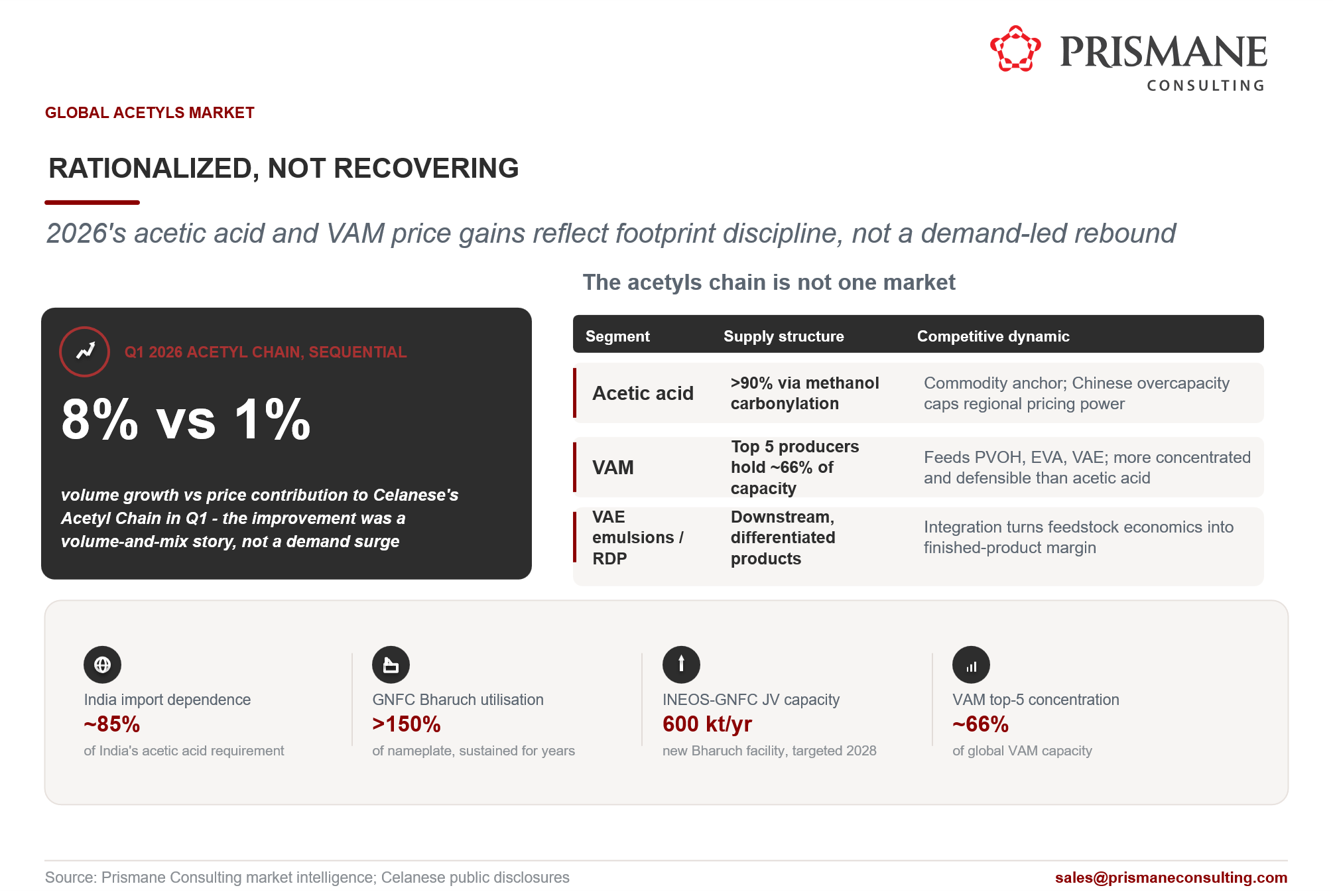
In the first quarter, Celanese's Acetyl Chain volumes increased approximately 8% sequentially, while price contributed only around 1%. The improvement was real, but it was primarily a volume-and-mix story layered on top of cost pass-through rather than evidence that global acetyls demand had suddenly accelerated. (By the second quarter, Acetyl Chain volumes were roughly flat year-on-year, as continued acetate-tow destocking offset gains in the vinyls chain.)
The distinction is important:
Prices are up. Volumes have improved in some areas. But structural oversupply has not disappeared.
That combination does not look like a conventional cyclical recovery.
It looks like an industry managing its own economics inside a market that has not fully healed.
There is no single acetyls market
One of the biggest analytical mistakes in acetyls is treating the chain as a single market.
It isn't.
The products occupy very different competitive positions, and value increasingly migrates downstream.
Acetic acid is the commodity anchor
More than 90% of global acetic acid production is based on methanol carbonylation, linking economics directly to methanol, carbon monoxide and ultimately natural gas.
That makes feedstock geography critical.
Acetic acid is also where Chinese capacity expansion has created the greatest structural pressure. Large-scale capacity additions have created a supply base that can remain long even when individual regions experience temporary tightness.
Consequently, a short-term price increase does not necessarily mean the global market has moved into structural shortage.
VAM sits further up the value chain
Vinyl acetate monomer occupies a different position.
VAM feeds PVOH, EVA, VAE emulsions and dispersible powders, which ultimately serve adhesives, coatings, paper, textiles, construction chemicals and high-barrier applications.
Several of these applications benefit from longer-term trends such as waterborne formulations, lower-VOC coatings and higher-performance adhesives.
The supply structure is also more concentrated. The largest producer holds roughly 18% of the global VAM market, while the top five account for close to two-thirds, based on Prismane Consulting's market assessment.
That concentration creates a very different competitive environment from commodity acetic acid.
Downstream is where integration matters most
VAE emulsions and re-dispersible powders move the chain further toward differentiated products.
This is where integration can turn intermediate feedstock economics into finished-product margin.
The result is a fundamental shift in where value is captured:
Acetic acid → VAM → VAE emulsions / re-dispersible powders
These are not simply successive products in one market.
They represent different levels of exposure to commodity pricing, feedstock volatility, differentiation and customer relationships.
A buyer purchasing spot acetic acid in Asia faces a completely different supply landscape from a formulator sourcing VAE emulsion in North America.
Calling both situations an "acetyls recovery" obscures the real dynamic.
The value, and increasingly the pricing power, is migrating downstream.
The recovery is largely self-help
The strongest evidence that this is not a conventional demand-led rebound comes from what producers are doing to their own portfolios.
The clearest lever is footprint.
Rather than waiting for a macroeconomic recovery, leading integrated producers have been pruning high-cost or strategically disadvantaged assets, restarting idled capacity where it captures share, and directing investment toward the most competitive parts of the network. Celanese is the clearest example. Through 2026 it accelerated the closure of its Lanaken acetate-tow plant in Belgium, while restarting its Frankfurt VAM unit — idle for more than six months — within weeks, to lock in share as the most reliable supplier during the Middle East supply crisis. Management describes this flex-up-when-scarce posture as a "coiled spring." With more than 80% of the Acetyl Chain's profitability historically generated in the Western Hemisphere, anchored by its low-cost Clear Lake, Texas complex, this footprint discipline — not a demand surge — is doing much of the work.
Removing structurally disadvantaged tons can tighten a producer's own supply-cost position even when overall demand remains subdued.
The second lever is mix.
The industry is increasingly directing capital toward higher-value downstream products, including VAE emulsions, while rationalizing exposure to less attractive commodity positions.
That is a portfolio decision, not a demand response.
Taken together, closures and downstream integration allow producers to improve realized economics without requiring a dramatic acceleration in end-market consumption.
That is what rationalization looks like in practice:
Close or flex high-cost capacity → improve asset utilization → integrate downstream → pass through feedstock costs → protect margin.
The important point is that this mechanism can support prices even when the underlying demand environment remains relatively soft.
Feedstock geography is becoming the real moat
Because acetic acid economics are fundamentally linked to methanol carbonylation, the decisive competitive advantage is increasingly determined by where the molecule comes from.
Producers with access to competitive natural gas and methanol, integrated carbon monoxide supply and strategically located production assets can defend margins under market conditions that are much more difficult for higher-cost producers.
The same feedstock shock does not affect every producer equally.
A rise in energy or methanol costs can compress the margins of a marginal Asian producer while having a much smaller impact on an integrated producer with advantaged feedstock economics.
This explains why cost pass-through can coexist with weak demand.
It is not necessarily evidence that pricing power has returned uniformly across the industry.
It is evidence that the strongest producers are better positioned to pass through costs while weaker producers absorb them.
That distinction will become increasingly important as the industry rationalizes.
China can remain oversupplied while other regions tighten
This is another reason the traditional recovery narrative is misleading.
A global market does not need to be structurally short for individual regions to experience tightness.
China can remain structurally long while Europe, North America or India experiences higher landed costs because of freight, trade restrictions, plant outages, regional production economics or limited domestic capacity.
That creates a market in which:
Global oversupply and regional tightness can coexist.
India is perhaps the clearest example.
India is moving in the opposite direction
If China represents the oversupply problem in acetyls, India represents the other side of the equation.
India remains structurally dependent on imported acetic acid even as domestic consumption expands across pharmaceuticals, textiles, coatings, adhesives, solvents and other chemical applications.
GNFC is currently India's sole domestic acetic acid producer, operating a roughly 100 kt/year facility at Bharuch that has run well above nameplate — at operating rates exceeding 150% — for years. Even so, domestic output falls far short of demand: India imports close to 85% of its acetic acid requirement, underscoring the gap between local production and consumption.
That is why India is becoming an important exception to the global rationalization story.
In November 2024, INEOS Acetyls and GNFC signed a memorandum of understanding to explore a new world-scale, 600 kt/year acetic acid facility at Bharuch, to be developed through a 50:50 joint venture and targeted for start-up around 2028. The investment is positioned around India's rapidly growing demand and the need to reduce dependence on imports. (We first assessed the implications of this project in our December 2024 analysis of India's methanol–acetic acid market.)
The strategic significance is bigger than the individual project.
China is adding capacity into a structurally long market. India is adding capacity into a structurally import-dependent market.
Those two tons may look identical on a global capacity table, but economically they are very different.
In China, another ton can intensify competition and prolong pressure on utilization and margins.
In India, another ton can replace an imported ton, improve supply security and support further downstream investment.
That distinction is critical when assessing where new acetyls capacity actually creates value.
It also reinforces a broader shift underway across the industry:
The acetyls industry is not simply adding or removing capacity. It is repositioning capacity geographically.
Capacity is increasingly moving toward locations where feedstock economics, domestic demand and supply-chain resilience justify investment, while structurally disadvantaged assets elsewhere face increasing pressure to rationalize.
For India, the implication extends beyond acetic acid.
A larger domestic acetic acid base strengthens the country's broader acetyls value chain and can support downstream derivatives, while simultaneously increasing the importance of domestic methanol economics. GNFC's existing methanol and acetic acid operations at Bharuch also give the expansion strategic relevance beyond simply replacing imports.
The result is a more fragmented global market:
China → structural surplus
Mature Western markets → rationalization and downstream integration
India → localization and capacity expansion
The next phase of the acetyls industry will therefore not be determined simply by global demand growth.
It will be determined by where demand is growing faster than domestic supply, where feedstock economics support competitive production, and where existing capacity has become structurally uncompetitive.
Pricing power is real, but narrow
None of this means that the current pricing strength is illusory.
It means that pricing power is becoming selective.
Integrated producers with feedstock advantages, competitive assets, downstream exposure and disciplined footprints can lead price and make increases stick.
Non-integrated commodity producers operating in structurally oversupplied regions face a very different reality.
For them, announced price increases can be much harder to translate into realized margins.
That creates an increasingly important distinction between:
price announced
and
price realized.
The difference is where competitive advantage becomes visible.
A producer with genuine structural cost advantage can use a tighter regional market to expand margins.
A high-cost producer may simply use the same market event to recover part of its cost inflation.
The headline price is therefore becoming a poor proxy for industry-wide profitability.
What this means for producers
For producers, the strategic priority is shifting away from simply adding capacity.
The more important questions are:
- Which assets are structurally competitive?
- Which plants are exposed to high feedstock costs?
- Where can downstream integration capture additional margin?
- Which commodity tons should be rationalized?
- Which regions provide the strongest combination of feedstock, logistics and customer access?
- How much pricing power can actually be sustained after competitors respond?
In other words, scale alone is no longer enough.
The stronger position is a combination of feedstock advantage, competitive assets, downstream integration and geographic access to resilient demand.
What this means for buyers
For buyers, the implications are equally significant.
The traditional procurement objective, securing the lowest available price, is becoming less reliable as a standalone strategy.
Regional tightness, producer rationalization and changing trade economics can quickly eliminate apparent arbitrage opportunities.
A lower-cost supplier may not remain the lowest-cost source once freight, tariffs, reliability and supply disruption risk are included.
For acetic acid and VAM buyers, supplier diversification and regional sourcing strategies are therefore becoming structural requirements rather than contingency plans.
The relevant metric is increasingly total delivered risk-adjusted cost, not simply the headline market price.
Prismane Consulting's Strategic View
The current market does not call for a simple "recovery" thesis. It calls for a more rigorous framework that separates price signals from structural change.
Our view is that producers, investors and buyers should focus on five questions:
- Separate real pricing power from cost pass-through. A price increase announced is not automatically a margin increase realized. The critical distinction is whether a producer can sustain higher margins after competitors respond, or whether the increase only recovers input costs. This depends on regional tightness, feedstock position and downstream integration.
- Follow value migration downstream. The acetyls chain is not one market. Acetic acid is a commodity anchor tied to methanol and gas economics, VAM sits in a more concentrated supply structure, and VAE emulsions and redispersible powders can offer differentiation and margin. Strategy must be built around where pricing power actually accumulates, not just where capacity sits.
- Map capacity by feedstock geography, not just by nameplate volume. Who can produce is less important than where the molecule comes from and at what cost. Producers with advantaged natural gas, methanol and integrated carbon monoxide positions can defend economics that higher-cost rivals cannot replicate. Regional feedstock profiles can shift the competitive order even before demand moves.
- Watch regional dynamics, not just global balances. China can remain structurally oversupplied while India, Europe or North America experience tightness due to trade flows, plant closures or import dependence. A global surplus can mask regional scarcity, and that scarcity is where pricing power becomes concentrated.
- Prepare for selective tightness rather than a broad-based recovery. If rationalization continues and regional demand growth in markets such as India accelerates, segments of the acetyls chain may experience tightness even while global operating rates appear comfortable. The next bottleneck may emerge not because the world runs out of acetic acid, but because certain grades, certain regions or certain downstream derivatives become undersupplied.
The implication is clear.
The next winners in acetyls may not be the companies with the largest global capacity. They may be the companies with the most defensible feedstock position, the strongest downstream integration and the deepest access to regional demand that is growing faster than local supply.
It would be easy to file 2026 as another noisy year in a cyclical commodity chain. We think that would be a mistake.
The acetyls industry is not simply recovering. It is being rationalized and geographically repositioned.
The strategic question has shifted. It is no longer simply:
"When does acetyls demand recover?"
It is:
"Where should the next ton be produced, who can produce it competitively, and who has the downstream and geographic position to capture its value?"
That is the distinction likely to define the next phase of the acetyls industry.
At Prismane Consulting, we look beyond headline pricing to understand where structural pricing power actually sits across acetic acid, VAM, acetic anhydride and VAE, where feedstock economics create durable advantage, where capacity rationalization is changing regional supply, how new investments such as India's emerging acetic acid capacity reshape trade flows, and why integrated players are increasingly optimizing their portfolios rather than simply waiting for demand to return.
Because in acetyls, where capacity sits, how competitively it operates and what sits downstream may matter more than how much the global market eventually grows.
Interested in understanding how these dynamics affect your acetic acid, VAM or VAE sourcing, investment or pricing strategy? Get in touch with Prismane Consulting.
Company pricing actions and results cited above are drawn from public announcements. Capacity, demand and market-share figures are based on Prismane Consulting's market intelligence and databases.