
Can paper replace plastic?
In 2026, that question is becoming too simplistic. The more important question is:
Which paper-based packaging technologies can deliver plastic-like performance, run economically on existing production systems, meet evolving recycling requirements, and scale across multiple markets?
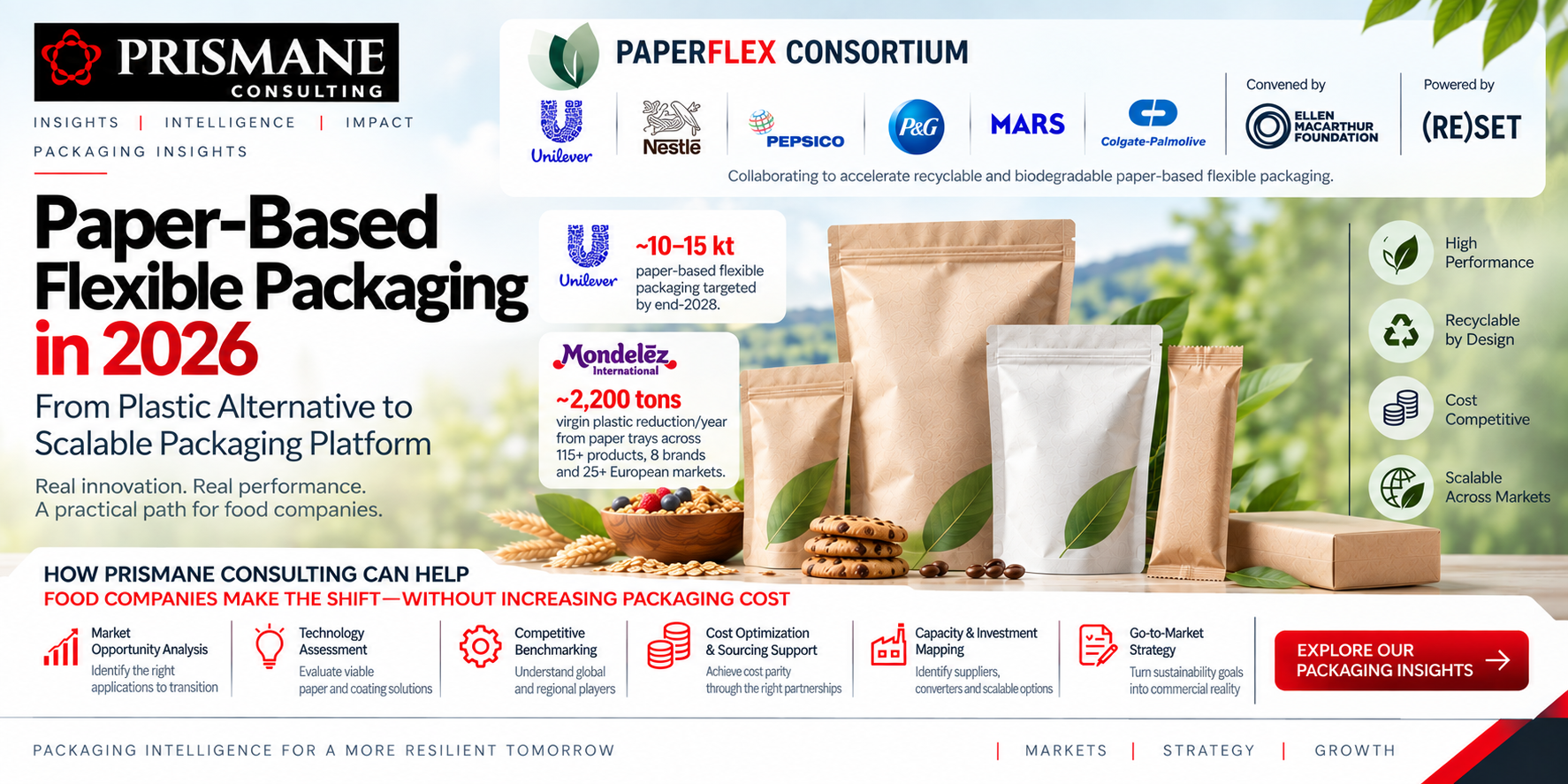
Two recent developments illustrate this transition. First, six global FMCG companies Unilever, Nestlé, PepsiCo, Procter & Gamble, Mars and Colgate-Palmolive have joined the PaperFlex Consortium, convened by the Ellen MacArthur Foundation and powered by (RE)SET, to accelerate the development and commercialization of paper-based flexible packaging. The consortium focuses on coatings, material technologies, manufacturing-line performance and end-of-life solutions, particularly in markets where small-format flexible packaging faces significant collection and recycling challenges.
Second, Mondelēz International has completed a major commercial conversion from rigid PET trays to FSC-certified paper trays across more than 115 cookie products, eight brands and more than 25 European markets. The company expects the transition to eliminate approximately 2,200 tons of virgin plastic annually, an approximately 80% reduction compared with the previous packaging system.
These developments involve different packaging formats flexible packaging in the PaperFlex initiative and rigid trays in the Mondelēz program but together they point toward the same structural change:
Paper is Moving from a Sustainability Concept Towards a Packaging Technology Platform
The transition, however, will not be determined by material preference alone. It will be determined by performance, economics, regulation, infrastructure and scalability.
PaperFlex Changes the Nature of the Industry Conversation
The significance of the PaperFlex Consortium extends beyond the six companies involved. Historically, FMCG companies, paper producers, coating suppliers, converters and machinery manufacturers have often worked on individual packaging challenges. The consortium introduces a more collaborative model around one of the industry's most difficult problems, i.e. small-format flexible packaging.
The Ellen MacArthur Foundation's underlying work identified six criteria for responsible paper-based packaging:
- Responsible sourcing
- Responsible production
- Technical, economic and consumer performance
- Local recyclability
- Avoidance of hazardous chemicals and persistent plastic pollution
- Alignment with a broader circular-economy strategy
Importantly, the foundation states that solutions meeting all these requirements do not yet exist at the required performance, scale and cost. The consortium is therefore not simply a declaration that paper has already solved the flexible-packaging problem. It is an attempt to accelerate the R&D and commercialization process.
That distinction matters. The next phase of paper packaging will be less about announcing prototypes and more about proving them under industrial conditions.
The Technology Challenge Is Moving From Material to System
Replacing a flexible plastic laminate with paper is not a one-for-one material substitution.
A conventional flexible plastic structure can simultaneously provide oxygen barrier, moisture barrier, grease resistance, heat sealability, mechanical strength, printability, lightweighting, high-speed machinability, product visibility or appearance and long shelf life.
A paper-based structure must reproduce an appropriate combination of these functions without creating an end-of-life problem. This is why coating technology has become one of the most strategically important parts of the paper packaging value chain.
Recent industry developments illustrate the direction.
- UPM and BASF have collaborated on fiber-based packaging combining UPM barrier papers with BASF's Joncryl HPB barrier technology.
- Henkel has expanded water-based barrier and heat-seal coating technologies designed to provide grease, water and moisture resistance while supporting paper-based recycling systems.
- Stahl has introduced its Repura portfolio targeting oil, grease, water-vapor and oxygen barrier requirements for paper and flexible packaging applications.
- Mondi has developed functional barrier papers covering applications from dry foods and confectionery to frozen food and home and personal care. Its portfolio includes solutions designed around different barrier levels and compatibility with form-fill-seal equipment.
The implication is significant: The competitive battleground is shifting from paper production alone towards paper + coating + converting + machinery integration.
Barrier Coatings Could Become the Enabling Technology
Paper itself is not necessarily the innovation bottleneck. The challenge is engineering a thin functional layer that gives paper the required performance without compromising recycling, compostability, food safety or manufacturing economics. This is creating opportunities across several technology categories:
- Water and Moisture Barriers: Critical for products exposed to humidity, condensation and wet environments
- Oxygen barriers: Important for products where oxidation affects shelf life, flavor, color or nutritional quality
- Grease and oil barriers: Especially relevant for snacks, confectionery, bakery, pet food and food-service applications
- Heat-seal coatings: One of the most important requirements for converting paper into commercially viable flexible formats
- Bio-based and biodegradable coatings: Potentially important in applications where accidental environmental leakage is a significant concern
- High-performance multilayer or hybrid barriers: These could continue to play a role where the performance requirements cannot yet be achieved through a simpler paper structure
Prismane Consulting is also increasingly focused on benchmarking bio-based polymers, nanomaterials and bio-nanocomposite coatings against oxygen, water-vapor, grease and water resistance requirements. The opportunity, therefore, is not simply a larger paper market. It is the development of a new functional-coatings ecosystem around fiber-based packaging.
Unilever's Commitment Shows the Shift From R&D to Deployment
One of the strongest indicators of commercialization is coming from Unilever. The company has reported that its packaging R&D teams have evaluated more than 3,000 emerging materials and technologies, particularly technologies that could function as barriers in flexible packaging. More recently, Unilever has committed to deploying approximately 10–15 kilotons of paper-based flexible packaging by the end of 2028, with progress linked to its Sustainability Progress Index framework. This is strategically important. It indicates that the industry is beginning to move through three distinct stages:
- Research
- Qualification
- Deployment
The first stage is about discovering technologies. The second is about proving performance, food safety, machinery compatibility and economics. The third is about running those solutions across actual commercial supply chains.
PaperFlex is effectively designed to accelerate the transition between these stages.
Mondelēz Demonstrates What Commercial Scale Looks Like
The Mondelēz development provides a different but equally important signal. Replacing PET trays across more than 115 cookie products, eight brands and more than 25 European markets is not a laboratory exercise. It requires procurement, specification, converting capacity, logistics, filling-line compatibility and quality control across multiple markets. The reported annual reduction of approximately 2,200 tons of virgin plastic demonstrates that packaging substitution becomes strategically meaningful when it is deployed across large product portfolios rather than individual SKUs. However, it is important not to interpret this as evidence that all rigid PET trays are about to disappear. The commercial viability of paper depends heavily on product characteristics, shelf-life requirements, distribution environment, packaging machinery, paper availability, coating requirements, local recycling infrastructure, consumer expectations and total packaging cost.
This means application-level economics will determine the pace of conversion.
Europe Is Becoming a Major Testing Ground
The timing of these developments is also important. The EU's Packaging and Packaging Waste Regulation began applying from 12 August 2026, creating a harmonized framework covering packaging throughout its lifecycle. The European Commission states that requirements concerning recyclability, recycled content and waste reduction will phase in over subsequent years, while a harmonized packaging labelling system is planned from 2028. The PPWR is therefore changing the investment equation.
Packaging decisions are increasingly being evaluated not only through:
- Material Cost
- Conversion Cost
but through:
Material + Conversion + Compliance + EPR + End-of-Life + Brand Positioning
The regulation is also immediately relevant to coating development. From August 2026, restrictions on PFAS in food-contact packaging began applying under the PPWR framework. For paper packaging manufacturers, this creates both opportunity and pressure. A paper structure that is technically recyclable but dependent on problematic coatings may not deliver the long-term solution that brand owners are seeking.
But Paperization Has Its Own Risks
The industry's transition from plastic to paper should not be treated as automatically sustainable. That would oversimplify the lifecycle. Paper packaging can introduce questions around:
- Fiber sourcing
- Forestry impacts
- Water consumption
- Coating chemistry
- Recycling yield
- Collection infrastructure
- Food-contact requirements
- Packaging weight
- Transportation efficiency
Coatings can also complicate recyclability, while food-contact applications may require specific fiber and barrier choices. This is precisely why the PaperFlex criteria are important. The future will not be defined by paper content alone. It will be defined by the performance of the complete packaging system.
Cost and Converting: The Next Competitive Battlefield
Technical performance is only half of the commercialization equation. A packaging supplier could develop an excellent paper barrier structure, but if it:
- Runs 20% slower
- generates excessive machine waste
- requires major equipment modifications
- has inconsistent sealing
- increases material consumption
- or significantly raises packaging cost
Brand owners may hesitate to scale it. This makes machinability a central technology metric. Mondi, for example, highlights the ability of selected functional barrier paper solutions to run on existing horizontal and vertical form-fill-seal equipment. That capability could be commercially decisive. The winning technologies may therefore not necessarily be those with the highest paper content.
They may be those that deliver the best balance of barrier performance, material efficiency, machine compatibility and end-of-life performance at an acceptable total cost.
Asia-Pacific Could Become the Next Major Opportunity
Europe currently provides a strong regulatory and commercial testing environment. But the PaperFlex initiative has explicitly identified markets where formal collection and recycling systems are limited as an important area of focus. This creates a particularly interesting opportunity across Asia-Pacific. India, Indonesia, Thailand, Vietnam, the Philippines and Malaysia combine large FMCG markets, high consumption of small-format packaging, expanding modern retail, significant informal waste-management networks, growing sustainability expectations, increasing EPR requirements and rapid packaging-conversion investment
Investment is also beginning to follow the broader circular-economy opportunity. Circulate Capital's Asia Fund II reached a US$ 220 million first close in 2026 and is targeting investments across South and Southeast Asia, including packaging and circular supply chains. For paper packaging, the opportunity is therefore not limited to Europe. The bigger opportunity could be developing region-specific paper-based solutions for markets where flexible packaging leakage and infrastructure constraints are most pronounced.
What This Means for the Paper Packaging Value Chain
The shift toward paper-based packaging creates opportunities across a much broader ecosystem than paper manufacturers.
- Paper producers: Demand could increasingly move toward high-performance specialty papers rather than commodity grades.
- Coating suppliers: Barrier, heat-seal, water-based, bio-based and biodegradable coating technologies could become critical value pools.
- Flexible packaging converters: Converters capable of running paper structures efficiently on existing equipment could gain an important competitive advantage.
- Packaging machinery companies: Machine compatibility, sealing technology, web handling and line-speed optimization will become increasingly important.
- Adhesive suppliers: Adhesives must support performance without undermining recyclability or end-of-life processing.
- Recycling companies: Paper-based packaging will create new requirements around collection, sorting, repulpability and fiber recovery.
- FMCG companies: The strategic challenge will be deciding where paper makes technical and economic sense, rather than simply maximizing paper content.
Five Questions Will Determine the Next Phase of Paper Packaging
From a market intelligence perspective, we believe five questions deserve close monitoring.
- Which applications transition first?Dry foods, confectionery, snacks and secondary packaging may move faster than highly demanding wet or oxygen-sensitive applications.
- Which barrier technologies reach commercial scale?The coating technology that balances protection, recyclability and cost will be particularly important.
- Can paper packaging run at existing line speeds?Machinability could determine whether technology remains a pilot or becomes a mainstream commercial solution.
- Where will new capacity emerge?The shift could create investment opportunities in specialty papers, coatings, converting and recycling infrastructure.
- What will the total cost of ownership look like?Material cost alone will not determine competitiveness. EPR, compliance, waste, machinery changes, logistics and end-of-life economics will increasingly matter.
Prismane Consulting Perspective
The launch of PaperFlex and the scale-up of paper trays at Mondelēz should not be interpreted simply as another chapter in the plastic versus paper debate. They represent something more important. The packaging industry is moving from material substitution toward packaging-system engineering.
Paper has already demonstrated that it can replace plastic in selected applications. The next challenge is considerably harder developing solutions that can operate across large volumes, multiple geographies, demanding production lines and diverse product categories while maintaining commercial viability.
That creates a broader competitive landscape involving:
Paper + Barrier Coatings + Converting + Machinery + Recycling + Regulation + Brand Strategy
The companies positioned across this value chain will increasingly compete on their ability to integrate these elements rather than on the performance of any single material.
At Prismane Consulting, we see the emerging paper-based packaging opportunity through this wider lens. Market sizing alone is not sufficient. Companies need visibility into application-level demand, technology readiness, barrier-coating economics, production capacity, competitive positioning, pricing, regulatory exposure and investment trends.
The central question for the industry is therefore no longer: “Can paper replace plastic?”
It is:
“Where can paper-based packaging deliver the right combination of performance, economics, recyclability and scalability?”
That is where the next generation of packaging value will be created.
Based on Prismane Analysis conclusion, the next phase of sustainable packaging will not be defined by paper replacing plastic. It will be defined by which packaging technologies can scale technically, economically and environmentally.
PaperFlex is an important signal that the industry is entering that next phase.
At Prismane Consulting, we track the evolution of paper packaging, flexible packaging, barrier coatings, molded fiber and converting technologies through market sizing, capacity mapping, technology assessment, competitive benchmarking and strategic opportunity analysis.
This article reflects Prismane Consulting's strategic analysis based on publicly available company announcements, industry developments and secondary research as of September 2026.