
When the Platform Becomes the Performance Contract
Automotive OEM coatings are no longer simply paint systems. They are becoming integrated manufacturing technologies that influence vehicle appearance, corrosion protection, durability, energy consumption, production efficiency, material compatibility and sustainability.
The automotive OEM coatings market is therefore entering a more technology-intensive phase. Vehicle manufacturers are increasingly evaluating coating suppliers not only on finish quality and formulation performance, but also on how effectively their systems integrate with increasingly complex paint-shop operations.
Asia Pacific remains the largest regional market, supported by its vehicle manufacturing base, while electric vehicles, lightweight materials, lower-energy curing, waterborne technologies and premium finishes are reshaping coating requirements.
The central shift is straightforward: the coating is increasingly being evaluated as part of the manufacturing platform rather than as an isolated chemical product.
Automotive OEM Coatings Market in 2026: Size, Growth and Key Trends
The global automotive OEM coatings market is influenced by vehicle production volumes, coating consumption per vehicle, technology migration, regulatory requirements and the increasing complexity of vehicle substrates and finishes.
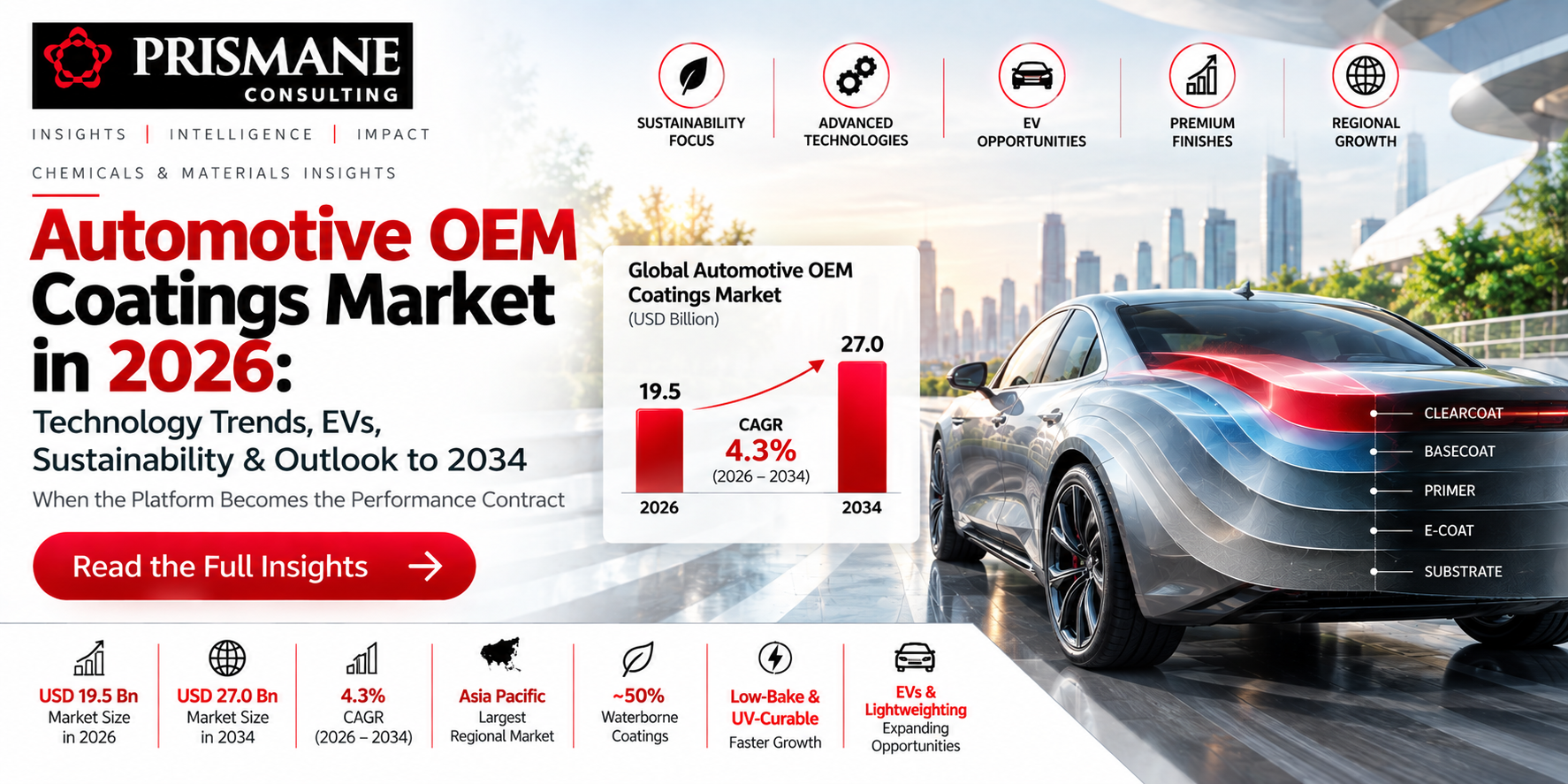
Automotive OEM Coatings Market Snapshot:
Market Indicator | Facts/Figures |
Global market size | USD 19.5 billion |
Projected 2034 market size | USD 27.0 billion |
CAGR, 2026–2034 | 4.3% |
Leading region | Asia Pacific |
Key technologies | Waterborne, high-solids, low-bake, UV-curable |
Major growth themes | EVs, lightweighting, energy efficiency, sustainability and premium finishes |
Source: Secondary & Primary Research and Prismane Consulting Estimates
The market is also becoming more differentiated by coating layer and application technology. Electrocoats, primers, basecoats and clearcoats increasingly need to work as coordinated systems rather than independent layers.
This creates opportunities for suppliers that can combine formulation chemistry, application expertise and process engineering.
Automotive OEM Coating Technology: From Formulation to Paint-Shop Performance
Historically, automotive coating performance was largely associated with attributes such as gloss, color, corrosion resistance, adhesion and durability.
These remain fundamental. However, OEM qualification is increasingly connected to what happens inside the paint shop.
A coating system must work within a defined manufacturing environment involving application equipment, oven configuration, bake temperature, line speed, film thickness, overspray management, pretreatment, drying and curing, rework requirements and substrate combinations.
Consequently, changing an approved coating can involve much more than replacing one formulation with another. A new system may require process adjustments, qualification testing, equipment compatibility assessments and validation across multiple vehicle programs.
This creates significant switching barriers and strengthens the strategic importance of technical collaboration between automotive coating manufacturers and OEMs.
The competitive question is therefore shifting from “Which coating has the best formulation?”
to
“Which coating system delivers the required performance within the OEM's manufacturing architecture?”
EVs and Lightweighting Are Changing Automotive Coating Requirements
The transition toward electric vehicles is creating new coating requirements across the automotive value chain.
EV platforms increasingly combine aluminum, high-strength steel, automotive plastics, composites and other engineered materials. These substrates can behave differently during pretreatment, coating application, drying and curing.
At the same time, vehicle manufacturers are examining coating technologies that can support lower energy consumption and shorter processing cycles.
EV-related applications extend beyond the traditional vehicle body. Coating opportunities are emerging around:
- Battery enclosures
- Electric motors
- Power electronics
- Thermal-management components
- Structural components
- Underbody systems
- Corrosion protection
- Fire and thermal protection
This is expanding the role of EV coatings from conventional exterior appearance systems toward functional materials that address electrical, thermal, mechanical and environmental requirements.
Lightweighting reinforces this trend. As OEMs seek to reduce vehicle mass, the combination of aluminum, advanced steels, plastics and automotive composites creates additional challenges around adhesion, corrosion protection, coefficient-of-expansion differences and surface preparation.
For coating suppliers, material compatibility is becoming a core technology requirement.
Automotive Coating Trends: Lightweighting, Functionality and Premium Finishes
Another important development in the automotive coatings industry is the growing emphasis on more functionality from thinner coating layers.
Lightweighting is not limited to vehicle structures. Coating systems themselves are also being evaluated for opportunities to reduce material consumption while maintaining performance.
This is encouraging developments in thin-film coating systems, multifunctional layers, wet-on-wet application, high-solids formulations, advanced clearcoats, improved corrosion protection and faster curing technologies.
At the same time, automotive design is becoming increasingly differentiated through color and surface effects.
Premium vehicles use a wider range of finishes, including metallic, pearlescent, matte, two-tone, color-shifting, high-gloss and special-effect finishes.
These finishes can increase formulation complexity because appearance must remain consistent across production lines while maintaining durability and repairability.
For OEMs, the challenge is balancing design differentiation with production economics.
For coating suppliers, this creates opportunities to develop systems that combine aesthetics, durability, application consistency and manufacturing efficiency.
Waterborne and Low-Bake Automotive Coatings Are Gaining Importance
The transition toward more efficient coating processes is increasing interest in waterborne, high-solids, low-bake and UV-curable technologies.
Waterborne automotive coatings remain important because they can help reduce reliance on solvent-heavy systems while meeting increasingly demanding appearance and performance requirements.
Low-bake technologies address another critical issue: energy consumption.
Automotive paint shops operate large-scale ovens and curing systems, making thermal energy a significant component of manufacturing requirements. Lower curing temperatures can therefore become strategically valuable when coating performance can be maintained.
UV-curable systems also have potential in selected automotive applications where rapid curing can provide productivity advantages.
However, technology adoption is not determined by environmental benefits alone. OEMs must evaluate:
Performance + process compatibility + capital requirements + energy consumption + throughput + total cost.
The technology that delivers the best balance across these factors is more likely to gain traction than a technology evaluated against a single sustainability metric.
Regional Trends in the Global Automotive OEM Coatings Market
Asia Pacific
Asia Pacific represents the largest regional opportunity in the global automotive OEM coatings market, supported by its concentration of vehicle production, component manufacturing and automotive supply chains.
China remains central to regional automotive manufacturing and EV production, while India and Southeast Asia are becoming increasingly important for vehicle manufacturing and supplier localization.
The region is also experiencing rapid diversification in vehicle platforms, production technologies and coating requirements.
Europe
Europe continues to place strong emphasis on environmental performance, manufacturing efficiency and advanced vehicle technologies.
The region's transition toward electric mobility and lower-emission manufacturing is supporting demand for coating technologies that can address energy efficiency, material compatibility and environmental requirements.
North America
North America remains an important automotive manufacturing market, with demand influenced by vehicle production, EV investment, plant modernization and changing vehicle architectures.
The regional opportunity increasingly extends beyond conventional vehicle-body coatings into functional and specialty coating applications.
Sustainability Trends in Automotive OEM Coatings
Sustainability is becoming increasingly integrated into automotive coating development and qualification.
However, sustainability in automotive coatings extends beyond simply reducing solvent content.
OEMs are increasingly considering VOC reduction, energy consumption during curing
material efficiency, coating thickness, overspray, waste generation, rework rates, raw-material sourcing, product durability and end-of-life considerations.
This makes the lifecycle performance of the coating system increasingly important.
Regulatory developments are also influencing the broader coatings industry. For example, the European Commission adopted Decision (EU) 2025/2607 in December 2025 establishing updated EU Ecolabel criteria covering decorative coatings & paints, varnishes, certain performance coatings and related products, as well as water-based aerosol spray paints. The criteria are set to apply through December 2032.
Importantly, such measures should not automatically be interpreted as automotive-OEM-specific regulations. Instead, they illustrate the broader regulatory direction toward environmental performance and more sustainable coating technologies.
For automotive OEM coating suppliers, sustainability is increasingly becoming part of product qualification, customer engagement and technology roadmaps.
Automotive Coating Raw Materials: Resins, Additives and Functional Chemistry
The evolution of automotive coatings is also creating new requirements for raw material suppliers.
Key components include acrylic resins, epoxy resins, polyurethane systems, crosslinkers, pigments, effect pigments, dispersants, additives, corrosion inhibitors, adhesion promoters and curing technologies.
The value chain is becoming increasingly interconnected.
A change in resin chemistry can influence viscosity, application behavior, curing requirements, adhesion and final appearance. Similarly, changes in pigments or additives can influence color consistency, weatherability and process stability.
This creates opportunities for specialty chemical companies that can provide application-specific solutions rather than commodity raw materials.
For the automotive coatings industry, innovation is therefore increasingly occurring across the formulation ecosystem rather than within finished coatings alone.
Automotive OEM Coatings Market Outlook to 2034
Looking toward 2034, the automotive OEM coatings market is expected to evolve around five interconnected themes.
Coatings Will Become More Integrated With Manufacturing
Coating suppliers will increasingly work alongside OEM paint-shop teams to optimize application, curing, energy consumption and line efficiency.
EV Platforms Will Expand Functional Coating Opportunities
Battery systems, electric motors, power electronics and mixed-material architectures will create additional demand for specialized coating technologies.
Low-Energy Processing Will Become More Valuable
Low-baked, faster-curing and other energy-efficient technologies could gain importance as OEMs seek to reduce manufacturing energy intensity.
More Performance Will Be Required From Less Material
Thin films, multifunctional layers and improved transfer efficiency can support material efficiency without compromising durability.
Premiumization Will Continue to Influence Formulation Innovation
Increasing demand for distinctive colors and surface effects will require coating suppliers to balance aesthetics with process consistency and durability.
The result is a market where technical differentiation will increasingly depend on the total performance of the coating system within the vehicle manufacturing process.
Strategic Implications for Automotive Coating Manufacturers
For automotive coating manufacturers, the next phase of growth will depend on more than expanding production capacity.
Four capabilities are becoming particularly important:
Technology depth: The ability to develop coating systems for EVs, mixed substrates, lower-temperature curing and advanced finishes.
OEM integration: The ability to work closely with customers during qualification, process optimization and vehicle-platform development.
Regional responsiveness: Local technical support and manufacturing capabilities will become increasingly important as automotive production expands across Asia-Pacific and other emerging manufacturing centers.
Sustainability-led innovation: Suppliers will need to demonstrate measurable improvements in VOCs, energy consumption, material efficiency and manufacturing waste while maintaining performance.
This changes the competitive landscape from a traditional coatings business toward a technology-and-process partnership model.
Prismane Consulting Perspective
The automotive OEM coatings market is moving beyond the traditional definition of paint.
The next generation of coating systems will be judged not only by how a vehicle looks after production, but by how efficiently and reliably that finish is achieved.
As EV platforms introduce new materials, manufacturing systems become more automated, energy efficiency becomes more important and sustainability expectations rise, the boundary between coating formulation and manufacturing technology will continue to narrow.
For coating suppliers, this creates both a challenge and an opportunity.
The strongest competitive positions will increasingly come from the ability to combine chemistry, process engineering, OEM collaboration and sustainability performance into one integrated value proposition.
By 2034, automotive OEM coatings are likely to be viewed less as a finishing material and more as an enabling technology within the vehicle manufacturing platform. That is where the next phase of value creation in automotive coatings will emerge.
Prismane Consulting tracks the global automotive OEM coatings market across vehicle segments, coating layers, resin chemistry, technology, regional demand, production capacity, EV adoption, paint-shop technology and supplier positioning, together with the upstream specialty chemicals that support the sector.
For market sizing, competitive intelligence or strategic assessments of automotive OEM coatings and related materials, contact sales@prismaneconsulting.com.